Quick Facts
- Functional Goal: Achieving 100% independence in daily living tasks and self-care routines.
- Economic Impact: Early intervention leads to an average healthcare cost savings of approximately $11,000 per patient.
- Safety Metric: Comprehensive discharge planning reduces 30-day hospital readmission rates by as much as 53%.
- Clinical Efficacy: Interventions for hand injuries show a large significant effect on motor function improvement, with a Hedges' g value of 1.53.
- Key Tools: Utilization of adaptive equipment to bridge the gap between physical limitations and personal autonomy.
- Integrated Care: Combining therapies can result in a 40% improvement in overall patient outcomes.
Occupational therapy recovery focuses on functional independence by helping patients apply physical strength to daily tasks like dressing and grooming, whereas physical therapy builds the underlying strength and range of motion. By focusing on task analysis and environmental modifications, occupational therapists help patients relearn life skills and conserve energy, ensuring a comprehensive approach to holistic rehabilitation.
The Engine vs. Traffic: Understanding Occupational Therapy vs Physical Therapy
When you are recovering from a major injury, your healthcare team will likely mention both PT and OT. To understand the difference, I often use the "Engine vs. Traffic" metaphor with my readers. Think of your body as a car. Physical therapy is focused on the engine—it ensures the battery is charged, the pistons are firing, and the structure is sound. They work on your gross motor skills, strength, and range of motion.
However, having a working engine doesn't mean you can drive through a busy city. That is where occupational therapy recovery comes in. Occupational therapists (OTs) teach you how to navigate the traffic of life. While a physical therapist helps you walk again, an occupational therapist helps you walk to the kitchen to safely make a cup of tea.
Choosing between occupational and physical therapy for injury rehab is rarely an either-or decision. In fact, they are deeply complementary. Physical therapy provides the physical capacity, while occupational therapy provides the functional application. For example, if you have a shoulder injury, PT works on the joint's rotation, while OT focuses on fine motor coordination so you can reach into a cupboard or button a shirt without pain.
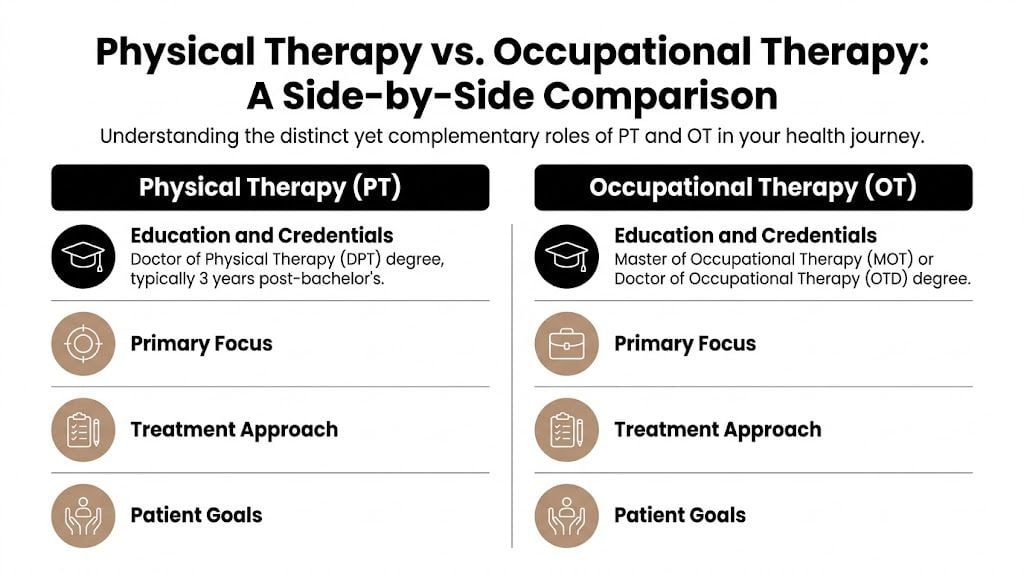
Physical therapy often builds the underlying physical strength and range of motion required before functional task training begins.

Relearning Activities of Daily Living (ADLs) Through Occupational Therapy
The heart of occupational therapy lies in activities of daily living rehabilitation. These are the essential tasks we often take for granted until an injury makes them difficult. OTs categorize these into two main groups: Basic ADLs (BADLs) and Instrumental ADLs (IADLs).
- Basic ADLs: These are fundamental self-care routines including bathing, dressing, grooming, and feeding oneself.
- Instrumental ADLs: These are more complex daily living tasks necessary for independent living, such as meal preparation, grocery shopping, managing finances, and cleaning the home.
The magic of OT happens through task analysis. An occupational therapist will watch you attempt a task and break it down into micro-steps. If you are struggling with dressing after a hip replacement, they won't just tell you to "try harder." They analyze the movement, identify where the restriction is, and introduce compensatory techniques. This methodical approach to relearning activities of daily living through occupational therapy ensures that you regain your autonomy safely and with less frustration.
Essential Adaptive Equipment for Independent Living After Injury
One of the most practical aspects of occupational therapy is the introduction of adaptive equipment for injury recovery. These tools act as a bridge, allowing you to perform tasks even when your physical strength or range of motion isn't yet back to 100%.
It is important to distinguish between Durable Medical Equipment (DME), which is often prescribed for safety (like a wheelchair or walker), and adaptive equipment, which is designed for function. Here are some of the most common tools used in a holistic rehabilitation program:
- Reachers and Grabbers: To pick up items from the floor or high shelves without bending or overextending.
- Sock-Aids and Long-Handled Shoehorns: Essential for maintaining independence in dressing when bending at the waist is restricted.
- Weighted Cutlery or Built-up Handles: Designed to help those with tremors or weakened grip strength manage mealtime.
- Dressing Sticks: Tools that help pull fabric over shoulders or legs.
- Modified Utensils and Plate Guards: To prevent spills and make eating a more dignified, independent experience.
By recommending essential adaptive equipment for independent living after injury, OTs ensure that the environment fits the patient, rather than forcing the patient to struggle against an inaccessible environment. Using adaptive tools for dressing and bathing after surgery can significantly decrease the risk of falls and secondary injuries.
Fine Motor Coordination and Upper Extremity Recovery
While physical therapists often focus on the "big" movements of the legs and back, OTs are the masters of the upper extremity. If you have experienced a hand, wrist, or elbow injury, occupational therapy techniques for upper extremity injury recovery are vital for regaining precision.
Hand therapy is a specialized branch of OT that focuses on the intricate mechanics of the hand. OTs use specific exercises to improve grip strength and fine motor coordination. You might find yourself using therapeutic putty, pegboards, or specialized sensory exercises to "wake up" the nerves in your fingers.
A common benchmark OTs use is the Nine-Hole Peg Test. This simple assessment measures how long it takes you to place and remove nine small pegs in a board. It is a gold standard for tracking progress in manual dexterity. This focus on precision is what allows a patient to eventually return to typing, playing an instrument, or performing surgery themselves.
OT Pro-Tip: Energy Conservation
During injury recovery, your body uses a massive amount of internal energy just to heal tissues. OTs teach the "4 Ps" of energy conservation: Prioritizing tasks, Planning your day to avoid rushing, Pacing yourself with frequent breaks, and Posture (using ergonomic positions to save effort).
Environmental Accessibility: Home Modifications for Safer Recovery
Recovery doesn't happen in a vacuum; it happens in your home. A significant part of occupational therapy recovery involves assessing your living space to ensure it supports your healing. Home modifications for safer occupational therapy recovery can be the difference between a successful transition and a trip back to the hospital.
OTs look for "trip hazards" and environmental barriers that might impede your progress. Simple changes can have a profound impact on your safety and confidence:
- Bathroom Safety: Installing grab bars in the shower and using a raised toilet seat to reduce the strain on hips and knees.
- Lighting: Increasing illumination in hallways and stairwells to prevent falls, especially for patients with neurological injuries.
- Kitchen Layout: Moving frequently used items to counter level to minimize the need for reaching or crouching.
Beyond the home, OTs also look at workplace accommodations. They help you transition back to professional life by suggesting ergonomic chairs, modified keyboards, or adjusted schedules. These energy conservation tips for patients in injury recovery are essential for preventing the chronic fatigue that often accompanies long-term rehabilitation.
FAQ
What is the role of occupational therapy in the recovery process?
The role of occupational therapy is to bridge the gap between physical healing and functional living. While other therapies focus on the body's mechanics, occupational therapy focuses on how those mechanics allow you to participate in your life. OTs assess your physical, cognitive, and environmental needs to create a customized plan that helps you perform the daily activities that are most meaningful to you.
What is the difference between physical therapy and occupational therapy for recovery?
The primary difference lies in the ultimate goal of the treatment. Physical therapy is generally focused on improving the body's physical function, such as reducing pain, increasing strength, and improving gross motor movements like walking or climbing stairs. Occupational therapy is focused on "the job of living," helping you apply your physical abilities to functional independence in tasks like bathing, working, or engaging in hobbies.
Can occupational therapy speed up recovery after surgery?
Yes, occupational therapy can significantly speed up the overall recovery timeline by preventing complications and teaching efficient movement patterns. By introducing adaptive equipment and energy conservation techniques early, OTs help patients become mobile and independent sooner, which reduces the risk of muscle atrophy and depression. Research indicates that OT-led discharge planning can also drastically reduce the likelihood of hospital readmission.
What are the main goals of occupational therapy in rehabilitation?
The main goals are to maximize functional independence, improve safety within the home and community, and enhance the overall quality of life. This involves a mix of physical exercises to improve fine motor coordination, cognitive strategies for task management, and environmental modifications to ensure the patient's surroundings support their current level of ability.
How can occupational therapy help someone regain independence?
Occupational therapy helps regain independence by utilizing task analysis to identify barriers to daily living and providing specific solutions to overcome them. This might include teaching compensatory techniques (new ways to do old tasks), recommending assistive technology, or modifying the home environment to eliminate obstacles. By focusing on the specific self-care routines of the patient, OTs empower individuals to care for themselves without relying on others.
Conclusion: The Path to Vocational and Personal Independence
Recovery is a journey that moves from the clinical setting back into the rhythm of daily life. While physical therapy builds the foundation of strength, occupational therapy recovery provides the tools and strategies to build a life on that foundation. It is a holistic approach that considers not just the injury, but the person, their environment, and their aspirations.
By integrating fine motor coordination exercises, the use of adaptive equipment, and home modifications, you aren't just surviving an injury—you are reclaiming your autonomy. Whether your goal is to return to the office, manage your own household, or simply enjoy a morning walk without assistance, an integrated approach to rehabilitation is your best path forward.

Choosing the right combination of therapies is the first step toward reclaiming your independence and returning to the activities you love.